Hunter Bellevue at Brookdale: Modernism and Modernity
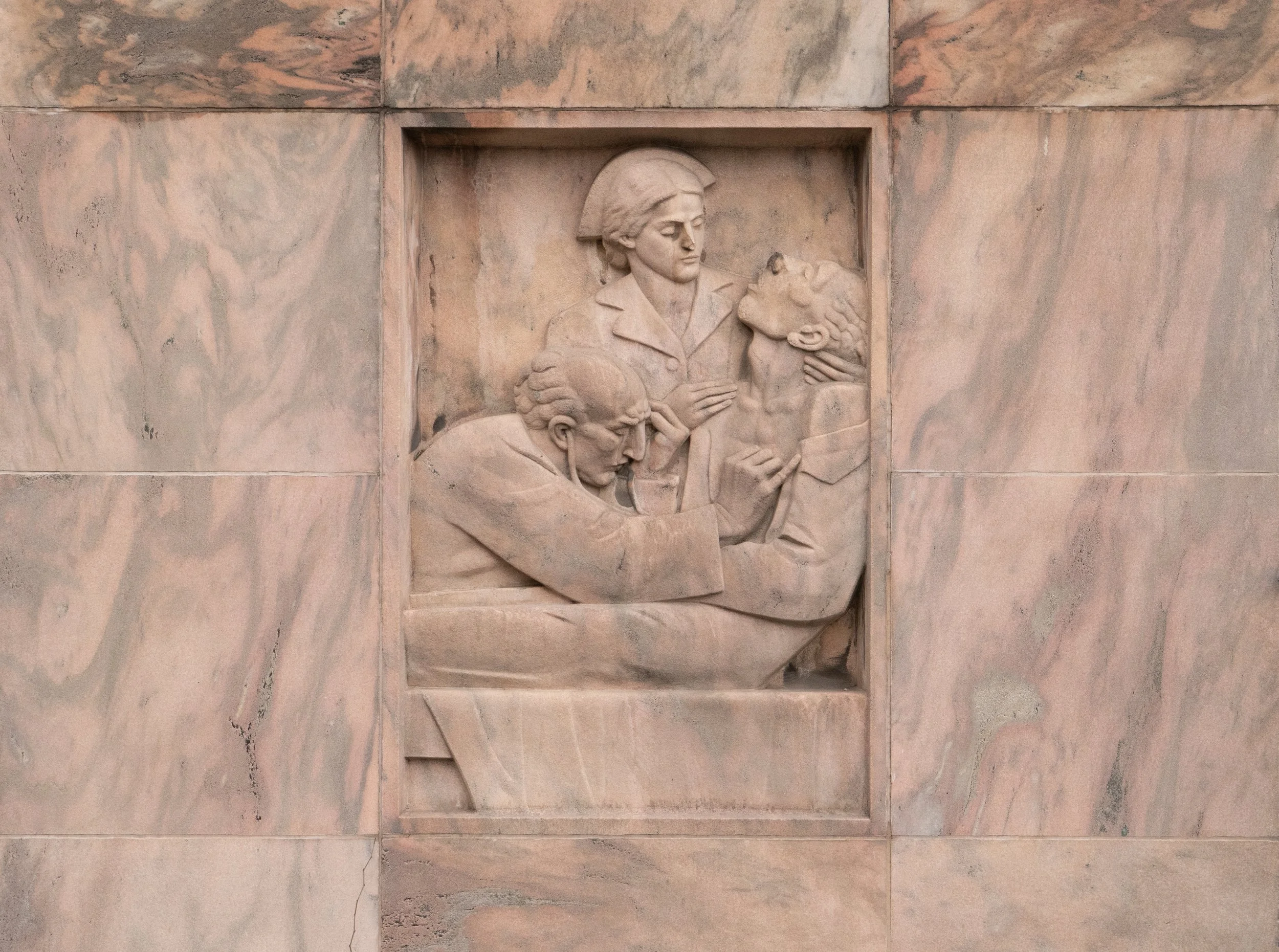
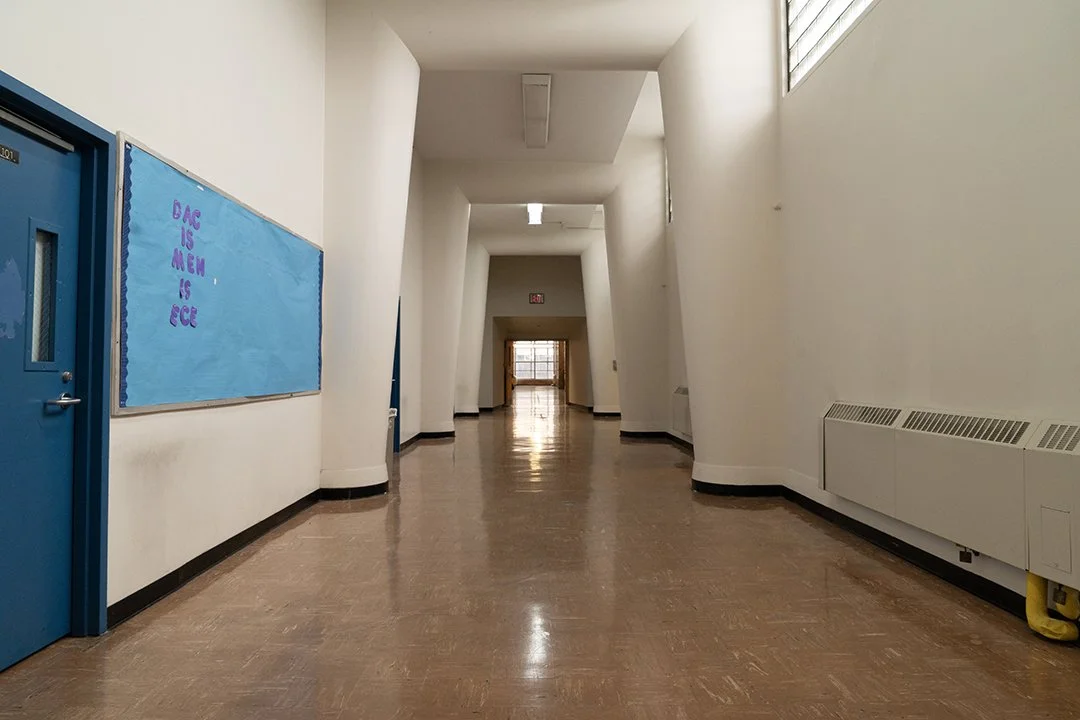
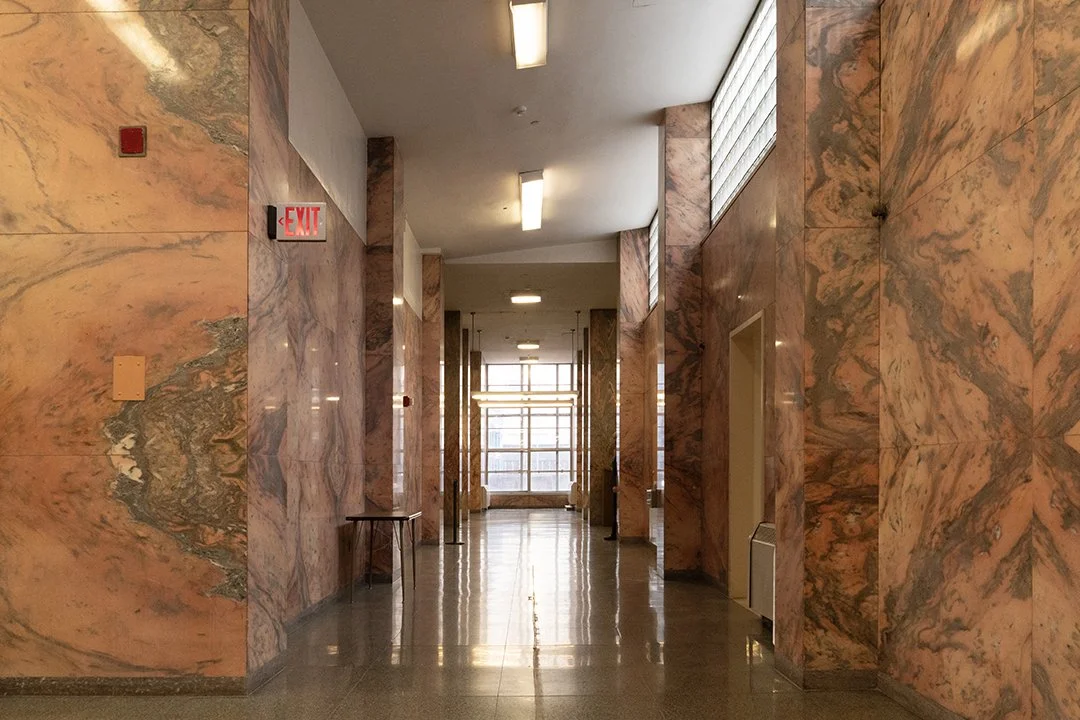
The veins of the salmon-toned marble compliments the clean-lined midcentury interior designed by La Pierre, Litchfield and Partners.
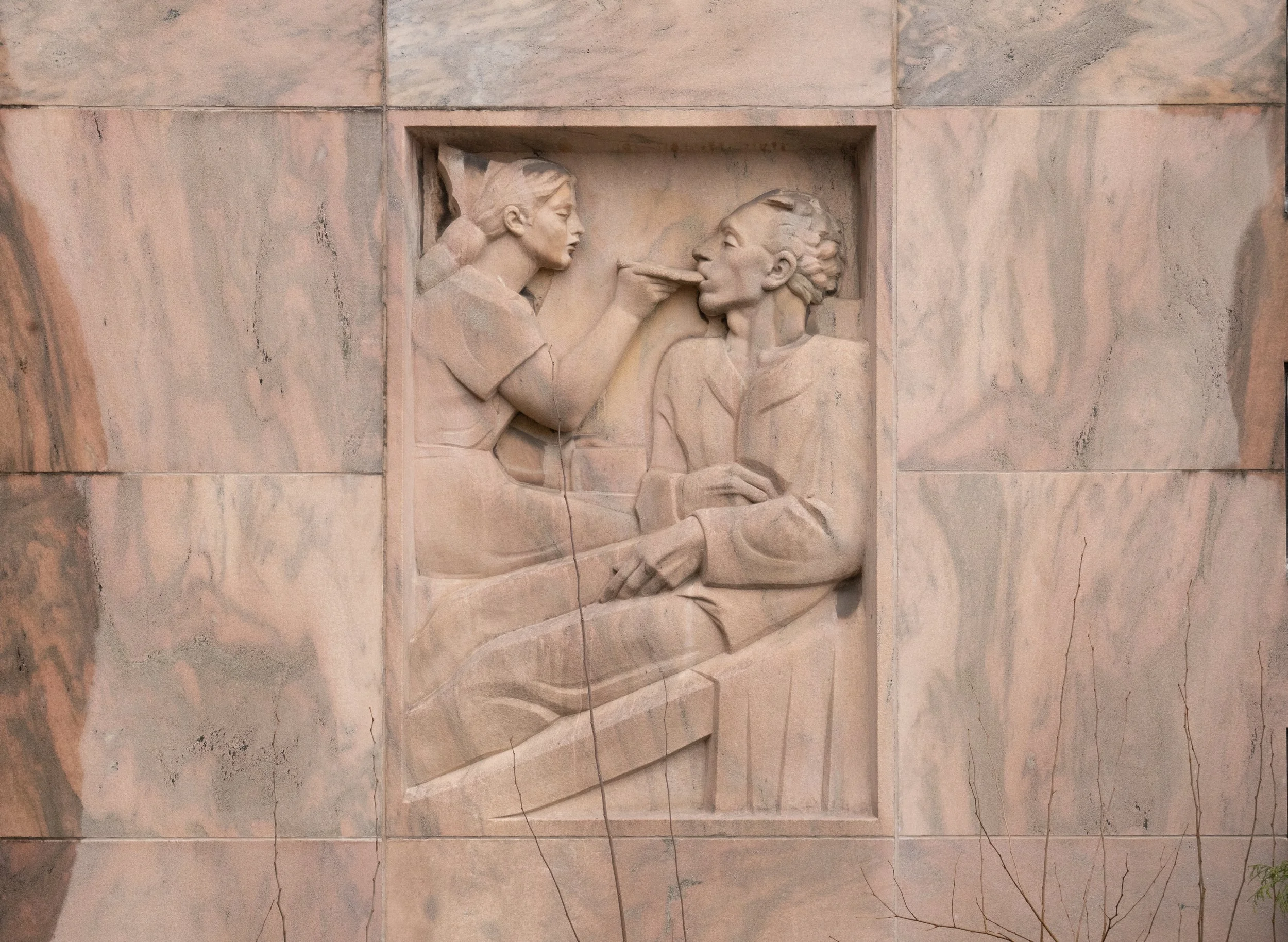
For seventy years, the Brookdale campus was a fortress of discipline, detailed in Art Deco steel-and-stone friezes. But as the last of the equipment is wheeled out, the dust is settling to make way for a $1.6 billion architectural adrenaline shot: SPARC Kips Bay.
The transition, which hit high gear in late 2025, marks the closing of a chapter overseen by those who knew these halls best. Martin Dornbaum, the campus’s unofficial historian and director of the Health Professions Education Center, has spent the last few months unpacking the campus legacy.
“This building was never meant to be a monument,” Dornbaum notes, reflecting on the school’s utilitarian roots. “It was built to house nurses, to support their work, and to make sure they were close to where care was happening.”
Yet, as the school prepares for its high-tech transformation, it’s hard not to feel the weight of the history being left behind. From the mid-century marble to the proximity to Bellevue Hospital, Brookdale wasn't just a school; it was the front line of public health for well over a century.
While the loss of a historic campus is bittersweet, the plan sets a steadfast course for the future. The campus is being transformed into the Science Park and Research Campus (SPARC), a massive innovation hub designed to reweave the site into the global life sciences corridor that defines First Avenue from 14th Street to 34th.
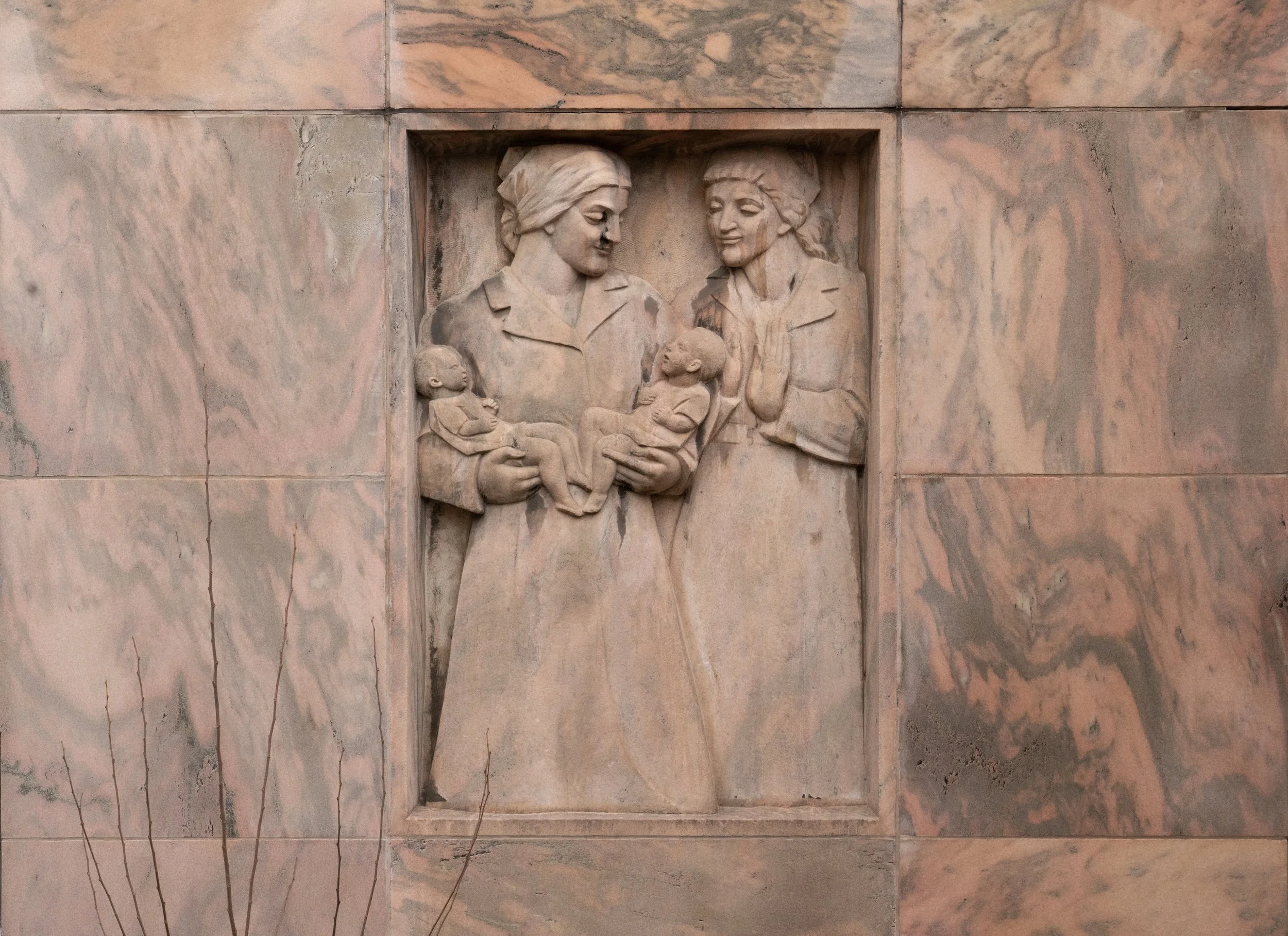
With its halls clad in pink marble, façade friezes carved in stone, and Deco steel rails framing stairwells, it is hard to believe the designers did not set out to make a monumental statement in 1952. Though architect Alfred Hopkins’ initial design impetus may have been form following function, the school’s history was far too illustrious not to have inspired grandeur in the details.
From Florence Nightingale to Deco Dorms
Well before Hunter entered that history, the school was known as the New York Training School for Nurses, which traces its origins to 1873. Dornbaum said the school’s founding principles were based in part on correspondence between Florence Nightingale and Dr. William Gill Wylie of Bellevue Hospital.
“This is where professional nursing in America really takes shape,” Dornbaum said of that exchange. “Not just in theory, but in practice.”
The letter provided detailed guidance that helped shape the school’s early structure and standards, emphasizing discipline, hygiene, and academic rigor. In time, the school became known for a series of firsts — among the earliest nursing pins, nursing caps, and standardized nursing uniforms in the United States, including popularizing the striped uniforms that later became associated with candy stripers.
“Everybody knows nurses with the pinstripe uniforms — the candy stripers — that started at Bellevue,” Dornbaum said. “These weren’t just symbols; they were markers of a profession defining itself.”
In an aside, he mused that while the uniform’s design is often attributed to Emelia Van Rensselaer, an acting superintendent, it is unlikely that someone of her prominent family background literally sewed the garment. More likely, Dornbaum suggested, she approved the final design.
The uniforms alone did not seal the school’s reputation; the women wearing them did. While Dr. Wylie deserves much credit, women from prominent and philanthropic families founded the school, and those on the front lines — the school’s nurses — were among the earliest contributors to nursing journals and instructional texts. Today, it is impossible to separate the school’s history from the longer history of nursing in the United States.
As that history expanded, so too did the need for larger and more efficient facilities. By the postwar period, the number of nurses trained at Bellevue had grown, requiring a building that Brookdale could meet in both efficiency and adaptability. Designed as both a residence and a school, the campus placed the women — primarily women — in close proximity to the hospital. Dornbaum noted that initial designs projected an eventual need for men’s dorms, though that was not realized until the late 1960s.
“The assumption was that nursing was not just a job, but a calling that structured your entire life,” Dornbaum explained. “The building reflects that.”
The nurses lived in a community with little privacy. If a "gentleman caller” arrived, visits took place downstairs from their dormitories in “beau parlors,” where matrons supervised encounters outside parlors with beveled-glass windows for muted semi-private encounters.
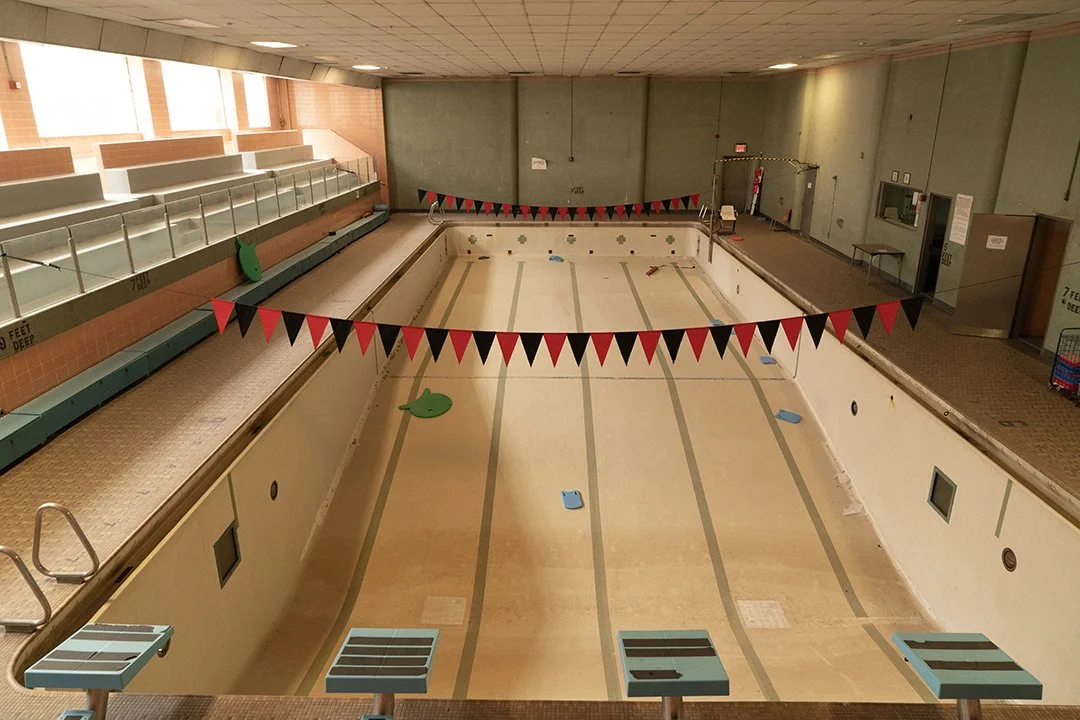
The visitor parlors were just one part of the campus’s holistic approach to nursing education. There were tennis courts, a swimming pool, a large gym, a generous game room, and a circular cafeteria offering sweeping views of the East River. Dorm rooms were small but private, with shared kitchens.
Modernism Meets the Moment
If private areas were compact, shared spaces — hallways, lobbies, and stairwells — were ambitious in scale. Here, materials such as pink marble signaled endurance. Quarried near Tate, Georgia, the stone came from one of the few domestic sources producing that hue, making it something of a signature for the campus. Steel detailing, including art deco railings framing the main stairwell, added needed curves to otherwise rectilinear spaces. Beyond the rotunda, the auditorium enveloped audiences in an amoeba-like interior, with recessed circles carved into the ceiling to reflect light throughout the room.
There were also dozens of classrooms, labs, study spaces, and a library. One lecture hall featured a rotating floor, allowing professors to show specimens from all angles to students seated in the round. Elsewhere were offices and meeting spaces, including a gem of a boardroom that fell into disrepair amid shifting institutional affiliations. Once the meeting room for the Bellevue School of Nursing Alumni Association — one of the oldest nursing alumni associations in the United States — it became unclear as the school integrated into Hunter College.
“When I first saw it, it had been neglected for years,” Dornbaum recalled. “Not because it didn’t matter, but because it fell between institutions.”
Through private fundraising, including support from a foundation dedicated to nursing education, the room was restored.
A Job Well Done
In its final days, the campus hosted generations of nurses who returned to bid the building farewell. Alumni from the Bellevue School of Nursing mingled with graduates of Hunter-Bellevue. Old uniforms were displayed alongside a wooden wheelchair, an incubator, and yearbooks dating back to the early twentieth century.
Amid the melancholy was also acceptance that the building’s time had passed. The school continued to grow, technology evolved, and the realities of building beside the East River became painfully clear after Hurricane Sandy. In areas that have since been closed, Dornbaum pointed to the waterline on the wall, marking floods that destroyed years of research.
“That was a reckoning,” he said. “Not just about repair, but about vulnerability.”
The flooding accelerated conversations already underway, as the school’s needs outpaced the facility’s ability to be retrofitted for contemporary standards. That reality, Dornbaum insisted, hardly diminishes Brookdale’s legacy.
“This building did exactly what it was supposed to do,” he said. “It supported generations of nurses and helped shape a profession.”
A Job Well Done
In its final days, the campus hosted generations of nurses who returned to bid the building farewell. Alumni from the Bellevue School of Nursing mingled with graduates of Hunter-Bellevue. Old uniforms were displayed alongside a wooden wheelchair, an incubator, and yearbooks dating back to the early twentieth century.
Amid the melancholy was also acceptance that the building’s time had passed. The school continued to grow, technology evolved, and the realities of building beside the East River became painfully clear after Hurricane Sandy. In areas that have since been closed, Dornbaum points to the waterline on the wall, marking floods that destroyed years of research.
“That was a reckoning,” he says. “Not just about repair, but about vulnerability.”
The flooding accelerated conversations already underway, as the school’s needs outpaced the facility’s retrofitting capacity to meet contemporary standards. That reality, Dornbaum insists, hardly diminishes Brookdale’s legacy.
“This building did exactly what it was supposed to do,” he says. “It supported generations of nurses and helped shape a profession.”